What I Learned, as a Mathematician, About Asking Artificial Intelligence the Right Questions
A book for teachers, researchers, and anyone who works with ideas
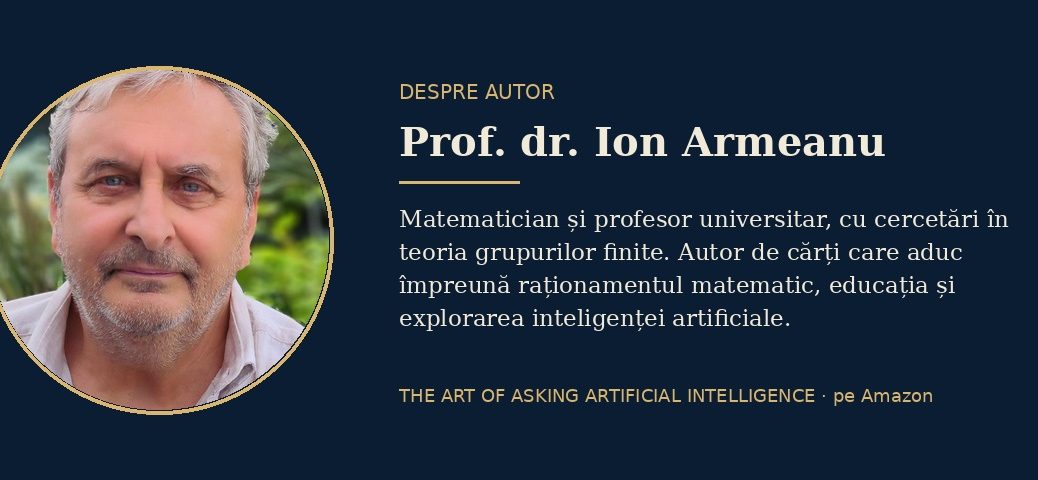
I am a mathematician and university professor. I have spent my career in the theory of finite groups, a field where a flawed proof can look perfectly convincing. Perhaps that is why, when I started working with artificial intelligence, I was not impressed by how fast it answers. I was interested in something else: when can I trust what it says, and how do I make it genuinely useful?
I quickly noticed that almost everything depends on the question.
A Trick Question
Ask an AI assistant:
“Who received the Nobel Prize in Mathematics in 1985?”
A correct answer should begin by pointing out the false premise: there is no Nobel Prize in Mathematics. A system that invents the name of a laureate instead is not answering the question. It is accommodating it.
The example is simple. The mechanism, however, appears in far subtler situations: book and article titles that do not exist, misattributed quotations, historical dates, statistical figures, bibliographies that look academic but cannot be confirmed. All of them are stated with the same confidence.
For anyone who teaches, writes, or does research, the practical question becomes: how do we establish whether information deserves our trust?
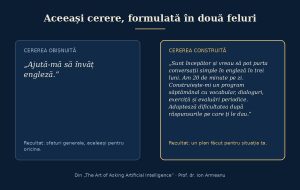
The Same Request, Asked Two Ways
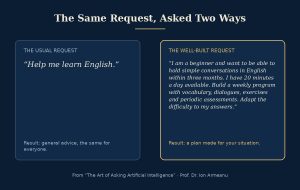
The usual request:
“Help me learn English.”
You get general advice, the same advice anyone else would get.
The well-built request:
“I am a beginner and want to be able to hold simple conversations in English within three months. I have 20 minutes a day available. Build a weekly program with vocabulary, dialogues, exercises and periodic assessments. Adapt the level of difficulty to the answers I provide during our conversation.”
Now you get a plan made for your situation.
The difference is not in the technology. It is in how we formulate the problem. In the book, a well-built request has seven components: objective, context, perspective, requirements, format, quality criteria, and working steps. I take them one by one, with examples.
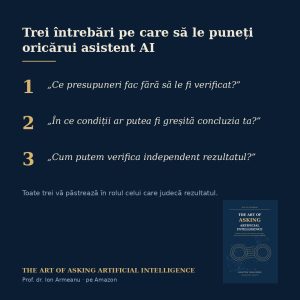
Three Questions You Can Use Today
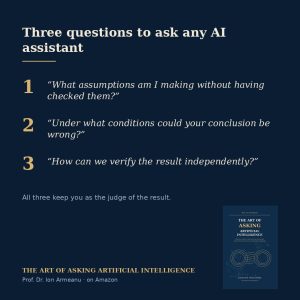
At the end of any important conversation with an AI assistant, try asking:
- “What assumptions am I making without having checked them?”
- “Under what conditions could your conclusion be wrong?”
- “How can we verify the result independently?”
All three keep you in the role of the person who judges the result, rather than simply accepting it.
These questions are only a beginning. In the book, I have organized them into a complete method.
What You Will Find in the Book
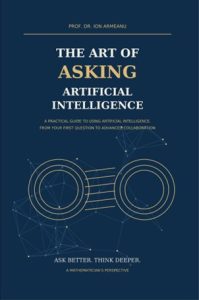
THE ART OF ASKING ARTIFICIAL INTELLIGENCE is a 252-page practical guide, from your first question to advanced intellectual collaboration with AI. Its 15 chapters show you:
- how to turn a vague idea into a precise instruction, with a universal working template;
- how to make ChatGPT a partner in reflection, not just a provider of answers;
- how to recognize errors, invented information, and deceptively convincing answers: a whole chapter is devoted to verification;
- how to use examples, context, and constraints to get exactly the result you want;
- how to organize complex projects in several steps;
- how to use AI as a personal teacher and as a research partner, including how to evaluate sources;
- a workshop of 50 concrete prompts, ready to use and adapt;
- the limits of artificial intelligence: responsibility, discernment, and the freedom to think.
The examples come from mathematics, science, education, professional work, and everyday life.
Who I Wrote It For
- Teachers who want to use AI to prepare their courses without losing control over the content.
- Researchers and PhD students who want a partner in exploration, not a text generator whose output must be checked endlessly.
- Anyone who works with ideas and wants to remain the author of their own conclusions.
The book’s motto says it all: let us collaborate intelligently with artificial intelligence without surrendering our own intelligence.
Where to Buy It
Kindle edition: read it on your phone, tablet, or computer, even while working with AI.
Buy the Kindle edition on Amazon
Paperback edition (252 pages): for readers who like to make notes on paper.
Buy the paperback on Amazon.com
Buy the paperback on Amazon.co.uk
If you have read the book, a review on Amazon, however short, helps other readers find it. Thank you.