THE ART OF ASKING: WHY BETTER QUESTIONS MATTER MORE THAN EVER
By Prof. Dr. Ion Armeanu
The Age of Unlimited Answers
For most of human history, knowledge was difficult to obtain.
Finding an answer often required patience, study, access to books, and sometimes years of intellectual effort. Today, artificial intelligence can generate explanations, arguments, summaries, and solutions in seconds.
We have entered an extraordinary age.
And yet, a curious paradox is emerging.
The easier it becomes to obtain answers, the more important it becomes to know what to ask.
Artificial intelligence has dramatically expanded our access to information. But information and understanding are not the same thing.
A person may receive a thousand answers without becoming significantly wiser.
Another may ask one carefully formulated question and discover an entirely new way of understanding a problem.
The difference lies not only in technology, but in the intellectual attitude of the person using it.
The Illusion of Instant Understanding
Imagine asking ChatGPT:
„Explain quantum mechanics.”
Within seconds, the system produces an explanation.
It may be clear, elegant, and reasonably accurate.
But have we understood quantum mechanics?
Not necessarily.
We may have acquired information without developing the conceptual framework necessary to evaluate it.
Now imagine continuing the conversation:
„Which assumptions underlie this explanation?”
„Can you illustrate the concept with an example?”
„Where does the analogy become misleading?”
„What evidence supports the theory?”
Suddenly, the interaction changes.
We are no longer merely receiving information.
We are investigating it.
And that distinction is fundamental.
The Question Behind the Question
One of the most valuable habits we can develop when working with artificial intelligence is learning to examine our own questions.
Suppose someone asks:
„How can I become more productive?”
AI can suggest time-management techniques, organizational systems, and practical routines.
But perhaps a more important question is:
„Am I spending my time on activities that genuinely matter?”
The first question concerns efficiency.
The second concerns purpose.
Artificial intelligence can help us explore both, but it cannot determine our personal values on our behalf.
That responsibility remains ours.
The Mathematics of Intellectual Honesty
As a mathematician and educator, I have always appreciated the difference between a convincing statement and a demonstrated truth.
Consider the expression:
(a + b)² = a² + b²
It looks beautifully symmetrical.
Unfortunately, it is generally false.
The correct identity is:
(a + b)² = a² + 2ab + b²
The missing term changes everything.
This elementary example illustrates a broader intellectual principle:
Elegance is not evidence. Confidence is not correctness. And a persuasive explanation is not necessarily a valid argument.
The same principle applies when working with artificial intelligence.
AI-generated responses can contain mistakes, unsupported claims, or fabricated references.
Therefore, asking better questions also means asking critical questions.
„How do we know this is correct?”
„What evidence supports this conclusion?”
„Could there be another explanation?”
These are not signs of distrust toward technology.
They are signs of intellectual responsibility.
From Asking Questions to Intellectual Collaboration
The most productive relationship with artificial intelligence is not necessarily the one in which the machine provides the fastest answer.
It may be the one in which the interaction helps us think more clearly.
We can ask AI to compare arguments, identify assumptions, suggest alternatives, explain difficult concepts, or challenge our initial conclusions.
We can use it as a learning assistant, a research aid, a creative collaborator, or a tool for organizing complex information.
But genuine collaboration requires participation from both sides of the interaction.
The human participant must remain intellectually active.
Otherwise, we risk transforming an extraordinary instrument of knowledge into a very sophisticated mechanism for avoiding thought.
And humanity has already invented quite enough ways to avoid thinking without requiring additional technological assistance.
What Should Remain Human?
Artificial intelligence will continue to develop.
Its capabilities may become increasingly impressive, and its applications may reshape education, research, business, and creative work.
But technological progress does not eliminate the importance of human judgment.
We still need curiosity.
We still need imagination.
We still need the courage to question assumptions.
And we still need the responsibility to decide what matters.
The purpose of intelligent technology should not be to make human intelligence unnecessary. It should help us use it more wisely.
A Book About Questions, Thinking, and Collaboration
These reflections inspired my book:
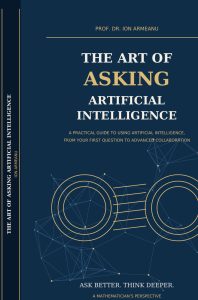
THE ART OF ASKING ARTIFICIAL INTELLIGENCE
A Practical Guide to Using Artificial Intelligence, from Your First Question to Advanced Collaboration.
The book explores practical approaches to using AI more effectively, from formulating clearer questions and evaluating information to developing ideas, supporting research, and collaborating creatively.
It is intended for curious readers, educators, professionals, entrepreneurs, writers, and anyone who wants to develop a more thoughtful relationship with artificial intelligence.
Because the future may not belong to those who collect the greatest number of answers.
It may belong to those who learn to ask the questions that truly matter.
Discover the book on Amazon:
https://www.amazon.com/dp/B0H9TZTWWB
Prof. Dr. Ion Armeanu — Author of The Art of Asking Artificial Intelligence
A question for readers: Has artificial intelligence changed the way you think, or primarily the speed at which you obtain information?